Howdy friends! I received a couple questions about the Canon T2i macro abilities…
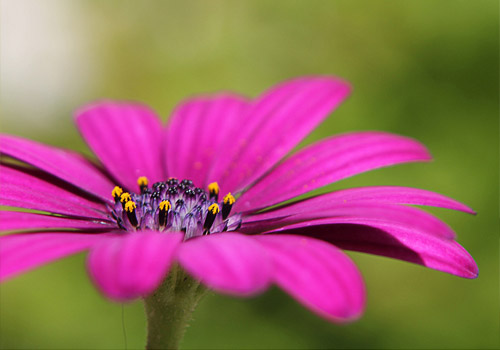
- Should I use the built-in macro mode on the T2i?
- Which shooting mode should I use for taking close-ups with the Canon T2i?
- Which focus mode should I use for taking close-ups with the Rebel T2i?
- Which macro lens would you recommend for a beginner T2i user?
- Do you have any macro photography tips for the Canon T2i?
Built-in Macro Mode for the Canon Rebel T2i
On the T2i mode dial you’ll see a little flower icon, this is the macro mode setting. Unfortunately, the macro mode on the T2i doesn’t work in the same way as a compact camera.
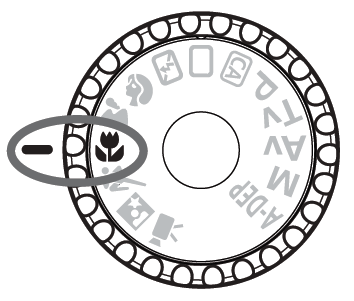
When you enable macro mode on compact cameras, the lens makes a minor adjustment and allows you to get in closer to your subject.
Macro mode on the T2i ensures that the image is properly exposed, however, it does not allow you to get any closer to your subject. I realize this can be very confusing, but keep reading…
In order to take macros with the T2i, you’ll need a proper lens or close-up conversion lens.
Now before you go out and purchase an expensive dedicated macro lens, you might want to check the lenses you already have in your camera bag. Many of the telephoto zoom lenses offered by Tamron and Sigma offer a macro setting located on the lens. When you enable the macro setting, it will allow you to focus much closer to your subject.
If your lens doesn’t have a macro setting, you also have the option of purchasing a macro conversion lens like the Raynox DCR-250 which attaches to the front of your lens.
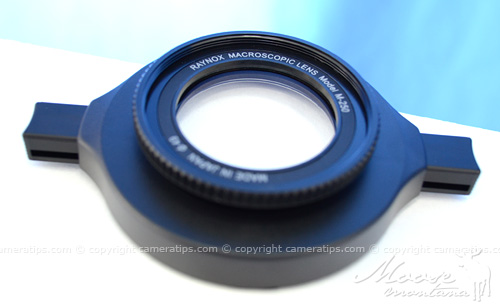
Macro conversion lenses basically magnify the image so that it fills the entire frame of your photo.
Best Shooting mode for taking close-ups with the Canon T2i
In most cases you’ll want an extremely shallow depth of field to get the area in front and behind your subject out of focus.

In order to control depth of field, you should enable Aperture Priority mode (Av).
- First rotate the mode dial to Av
- Locate the aperture f-number on the back of the LCD screen
- Rotate the little command dial which is located just behind the shutter button.
- If you rotate it to the left you will get a lower f-number and if you rotate it to the right you will get a higher f-number.
- For macros, you will want the lowest f-number possible. The lowest available f-number will be determined by your lens.
Now that you’ve got the T2i shooting mode set up correctly, you’ll want to choose the right focus mode.
Best Focus mode for taking close-ups with the Canon T2i
For macro’s, you’ll want to ensure that your T2i is set to One Shot focus mode. You can reference page 66 of the Canon T2i manual to enable One Shot focus mode.
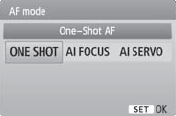
In One Shot focus mode, when you half press the shutter to focus on your subject the T2i will lock focus. You can then re-compose the shot for more creativity.
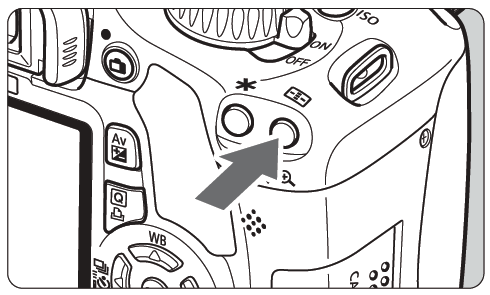
If you’re having trouble focusing on your subject, like a small bug in the middle of a flower, then you should manually set the focus point to the center of the frame. To enable the center focus point, just click the manual focus point button (shown below) and press the SET button.
Macro lenses for beginner Canon Rebel T2i users
For beginners on a budget, I recommend purchasing the Raynox DCR-250 Super Macro/Close-Up lens and coupling it with the kit lens or the very popular Canon 50mm f/1.8 lens.
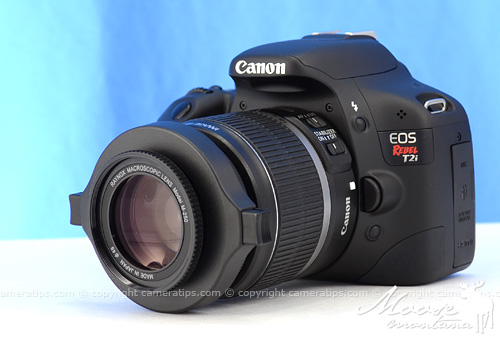
The Raynox DCR-250 clips on to the front of most lenses and will give you amazing macro abilities right out of the box.
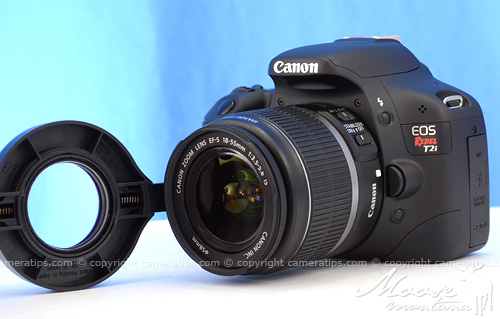
My wife has used the Raynox DCR-250 with the kit lens and taken some truly beautiful macros, some of which are now framed in our house.
For beginners on a budget looking for a zoom lens with built-in macro abilities, I would recommend the Tamron 70-300mmtelephoto lens or the Tamron 18-270mm all-in-one lens. While these lenses will give you pretty decent close-up abilities, the image quality is no where near that of a dedicated macro lens like the Canon 60mm EF-S f/2.8 lens.
If I had to give you one answer, I would say start with the Raynox DCR-250 macro conversion lens. At a price point of $60 bucks, the DCR-250 will immediately improve the macro abilities of your Canon T2i and kit lens.
Macro tips for the Canon Rebel T2i
Get on the same level as your subject
Instead of shooting over the top of your subject, try shooting at the same level or even slightly below your subject to draw more interest.

Use a tripod
When your hands are free from the T2i, you can manipulate or hold the subject for composing your shots. This is especially helpful on windy days, where you can shield your subject or stabilize it to minimize blur. I recently purchased and tested the budget Dolica Proline Tripod and can highly recommend this as a great starter tripod for beginners.
Don’t just shoot plants and insects
Flowers and insects are very popular macro subjects, but there are many other subjects you can shoot…including friends, family and even pets. For more abstract and creative macros try taking shots of hands, feet, eyes and smiles.

Shoot against simple backgrounds
Busy backgrounds can be distracting. Try angling the T2i so that you are shooting against the sky or a solid background. Another popular technique is to use colored poster board. With the T2i on a tripod, you can hold the colored poster board of your choice behind your subject for eye popping results. I prefer black, as it really makes your subjects pop.
I hope you enjoyed this macro tutorial for the Canon Rebel T2i. Happy Shooting! :)


thnx for these great tips…..this is one of the best sites on photography…Bookmarked!!
Glad to have found your page.
Just the info i was looking for. I do like the idea of being able to remove the Raynox DCR-250 so i can get the shot of a bird with out change the lens… Thanks, Mark
Just like to know about the Extension tube, How will be the macro Effect using an Extension Tube
Howdy Sanyo,
I’ve never been a big fan of extension tubes. They do increase the focus distance, however, the tubes fit in between your lens and the T2i so there’s no way to quickly remove the extension tube for a non-macro shot. If you’re out in the field, it makes it very hard having to change the setup each time you want to shoot a macro or non-macro shot. I prefer dedicated macro lenses or macro converters like the Raynox DCR-250 which can be easily attached and removed.
- Moose
Hey,
I was wondering if a ring flash would attach to the Macro lens adapter or if I should look into buying an actual ring flash?? (I’m an entry level photographer and not looking to spend too much money yet)
Howdy Eddie,
It depends on the type of ring flash you’re purchasing. Some of the third party ring flashes come with adapter rings that can attach to a variety of different filter sizes. The Raynox DCR-250 has a 49mm front filter element, so if the ring flash comes with a 49mm adapter ring, then you’re good to go!
- Moose
Per your advice I purchased the Raynox DCR-250 for my Canon Rebel t2I. I took some 60 pictures and many pic’s came out better then I expected. Actually I was somewhat amazed that I first time amateur could get these kinds of results. Counting the days for spring time to take pic’s of everything from buds to bugs.
My new passion is marco photos.
I know I speak for many in saying thank you so very much in regards to providing such valuable information.
Kenny Crawford
Howdy Ken,
Glad to hear the Raynox macro converter worked out for you…happy shooting!
- Moose
Moose you just saved me a ton of money! I’m in the process of buying my first Canon (non-point and shoot I should say) and I’m super excited for my t2i to get here this Friday. (They say it’s on the truck) I was planning on buying a macro lens that costs about $549 per someone else’s recommendation but now I think I’ll just buy me the Raynox DCR-250 thanks to your super advice. I have subscribed to your website and I’m eager to find what other treasures of advice you have tucked away in here! Thanks!!!
Howdy Erin,
Ah, nothing like anticipation…congrats on the new cam! :)
Glad to hear you’re enjoying my tips and recommendations! You’ll have a lot of fun with the Raynox DCR-250. Most people are surprised at how close they can get to their subject with it attached to their lens. Happy shooting!
- Moose
Moose -
You have a GREAT site, thank you!!
I have a T2i with the Canon 18-55 and 55-250 IS lenses.
I looked at the Raynox, but I want to get a dedicated macro lens. After a little digging, I thought the Tokina AT-X 35mm f/2.8 PRO DX Macro Lens would be a good choice. Before I committed to buy this, I saw that Tokina also makes a 100mm f/2.8 macro lens. The 100mm is just over $100 more than the 35 – but other than that, could you comment some on the major pros and cons of macro lenses with different focal lengths??
Marco,
Thanks for the kind words…the biggest difference between a 35mm and a 100mm macro lens is the focusing distance and how it applies to lighting.
A 35mm lens will get you extremely close to the subject, however, it’s very easy to block out the sun when shooting outdoors and very hard to light the subject indoors (flash or direct light).
A 100mm macro lens will allow you to achieve super tight framing while keeping a distance between you and your subject so the light can hit it. Happy shooting!
- Moose
Moose,
Thanks for the prompt and informative reply!
If I read you right, it sounds like the biggest difference is the price. If I can live with spending the extra C-Note, it sounds like the 100mm lens is going to be more versatile, giving me more room to work between the end of the camera and what I’m trying to shoot.
Glad I asked!
Marco,
Yep, you got it…happy shooting!
- Moose
Moose,
I was going to be purchasing canon’s 50mm f1.4 in the near future. it will be my first lenses purchase. (i chose over the 1.8 cause can tell a difference in the sharpness after using both). i was wondering if the raynox works well with the 50mm 1.4. i would like to have the opportunity to take nice macro shots but as im on a strict budget, im limited to options. i was just wondering if this is still the best option for budget macro out there
also what lightweight tripod would you recommend now. after reading a couple of your articles i’ve run across a couple of different tripod recommendations.
Also would if the Raynox is still the best would you recommend the 250 or the 150?
curses! i always think of more questions after i just finish posting.. sorry for the triple post but would you recommend any flash products for macro photography? are they necessary when getting extremely close. if so what would be the best ring flash to buy?
Corban,
The 50mm f/1.4 is a great lens, super sharp and well worth the extra cost if you’re budget allows.
The Raynox DCR-250 will work beautifully with that lens. The key is to get extremely close to your subject. Some people attach the Raynox macro converter and try to focus a couple feet away…all you’ll end up with is blurry, out of focus shots.
As for lightweight tripod recommendations, if you’ve got the budget I would go for the Davis & Sanford voyager lite tripod (see here). It’s compact, lightweight and very well made.
Definitely go with the Raynox DCR-250, you’ll appreciate the increased macro power.
I wouldn’t yet invest in a macro ring flash…they’re expensive and they take some practice to get right. I’d suggest a macro ring light as it provides a constant light versus a short burst of light. The constant light will allow you to adjust your settings without having to compensate for flash. The macro ring light I linked to is both affordable and will effectively illuminate close-up subjects. Happy shooting!
– Moose
Moose,
Beyond the converter (and just to sate my curiousity) do you have any suggestions on proper lenses for Macro that match up with our cropped sensor T2i? Based on my research, a lot of macro lenses out there seem to be rated more for the proper focal lengths for a full sensor camera – so, I’d be curious about the top three you would choose for the T2i?
Debo,
Sorry for the late reply, got busy with the holiday season… If you’re looking at dedicated macro lenses I would suggest either the Canon 60mm f/2.8 or the Canon 100mm f/2.8. Both lenses are super sharp from edge to edge and offer USM which is important for quick and quiet focus. Of the two, I would start with the 60mm just based on price alone.
- Moose
Better a long time between the reply than none at all! Appreciate it Moose!
I would like to purchase a fisheye lens for my T2i. What is your opinion on the the new EF 8–15mm f/4L USM fisheye lens?
Blossom,
Sorry for the late replay, been busy with family and the holidays… Other than being the world’s first fisheye zoom lens to offer both circular and full frame images, the Canon EF 8–15mm f/4L USM looks to be a valuable lens for those who enjoy extreme wide-angle shots. I can also see this lens becoming very popular among beginner filmmakers for creative video segments.
- Moose
Would the tips for the Canon T2i be the same as for the T1i that I just bought…? I hope I didn’t buy the wrong camera just to save a buck.
I’m loving your site and all the information listed here. I just decided to cancel the class on how to use a canon camera, offered at the local community collage. I’m learning quite a bit here.
Rod,
Yes, many of the tips for the T2i can apply to the T1i. The T1i is a great camera so don’t feel like you bought the wrong one. The biggest difference between the two is in the video department, so unless you need that feature the T1i will suit you just fine. Glad you’ve found the info/tips helpful! :)
- Moose
Thanks for your great information!
Which close-up lens can I use with a Canon 75-300mm lens?
Laurie,
Glad you found my site! The Raynox DCR-250 close-up filter will fit the Canon 75-300mm lens.
- Moose
Hi,
Is there a closeup lens out there that can fit Canon 18-200mm lens? Thanks
Ban,
The Canon 18-200mm lens has a 72mm lens thread, so you’d have to go with the more expensive Raynox DCR-5320PRO which includes 2 macro conversion lenses that you can stack for extreme close-up ability. You can find them at B&H Photo.
- Moose
Moose, does the Raynox DCR-250 fit the standard Ef-S 18-55mm Lens that comes with T2i?
Hi Dee,
Yes, it actually clips on to the front of the lens (similar to a lens cap) rather than screwing in to the front lens element. This makes it easy to add and remove the adapter for macro shots.
- Moose
Great advice Moose, I’m looking forward for new ways to shoot.
Daniel,
Thanks, glad to have to have you stop by!
- Moose
great article!
i am looking for an inexpensive way to obtain macro shots while filming and it seems as if the raynox is the best way to get my feet wet.
thanks!
Melinda,
Thanks for the compliment, glad to have you stop by! The Raynox should get you started in the right direction. When filming macro shots, I highly suggest you enable manual focus and use a tripod, this will give you the best results. If you’re hand holding the T2i and using continuous auto-focus, it will go in and out of focus as you make small movements with your hands. Shooting with a steady tripod will eliminate all of that.
- Moose